3PL and logistics
More pallet positions in the same leased building means more client capacity without moving sites.


What if you could store more without adding a square metre?
When the warehouse is full, the obvious answers are a bigger building or off-site storage, and both are expensive. In conventional pallet racking, a large share of the floor goes to aisles, because forklifts need room to reach every pallet.
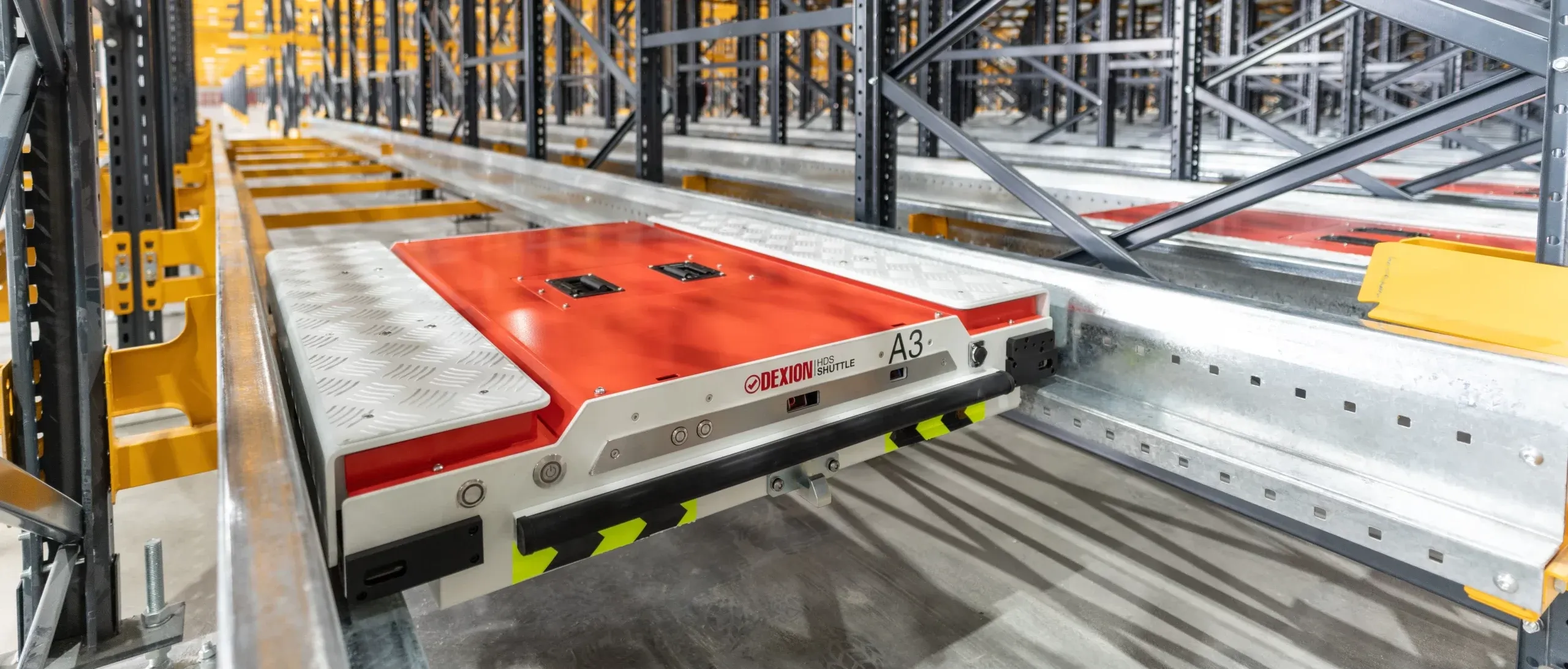
Pallet shuttle storage removes most of those aisles. Pallets are stored in deep lanes, and a shuttle running on rails inside the racking carries each pallet in and out. Forklifts only work at the face of the racking.
Start with semi-automated HDS shuttles controlled by your forklift drivers, or go fully automated with MDS 4-way shuttles that store and retrieve pallets by themselves, connected to your WMS.
Every shuttle project starts with your pallets and your throughput, not a standard rack layout.
We review your building, pallet types, SKU profile and in/out volumes, decide between HDS, MDS or a mix, and design lane depths, levels and shuttle count.
We install the racking, rails and shuttles. For MDS, we connect the system to your WMS through SASCA so every pallet movement is directed by live data.
We train your drivers and team, tune performance after go-live and support you locally. As volumes grow, we add shuttles, lanes or levels.
Deep lanes replace most aisles. MDS increases storage capacity up to 3x compared with conventional racking.
Forklifts never drive into the racking, which reduces rack damage and keeps people out of the lanes.
Drivers drop a pallet at the lane face and move on while the shuttle does the rest.
Lanes run first-in-first-out, last-in-first-out, or both, to suit stock rotation and expiry dates.
Less spent on extra buildings, off-site storage or, in a cold store, refrigerating empty aisles.
Add shuttles, lanes or levels as volumes increase. The modular MDS design expands without replacing what is installed.
More pallet positions in the same leased building means more client capacity without moving sites.
Every refrigerated cubic metre costs money. Removing aisles shrinks the space you cool and keeps forklifts out of the lanes.
Many pallets of fewer SKUs is the ideal shuttle profile. Fast put-away and FIFO lanes handle strict stock rotation.
Most sites are closer than they think. These are the areas we review in our assessment. If one isn’t in place yet, we’ll help you plan for it.
Clear height, slab condition and column positions decide how many levels and lanes fit. Deep-lane storage can affect sprinkler design, so we review fire requirements early.
Shuttles run on rails under the pallet, so pallets need to be a consistent size and in good condition.
Few SKUs with many pallets suit HDS. More SKUs or higher throughput suit MDS.
Can’t find yours? Call us on 0401 045 297.
High-density racking where a battery-powered shuttle carries pallets along deep storage lanes. Forklifts only load and unload at the front of each lane, which removes most aisles.
It depends on your building and layout. Dexion’s MDS increases storage capacity up to 3x compared with conventional racking. We model the exact pallet count for your site during design.
In most cases, yes. With drive-in racking, forklifts drive into the racking, which is slower and causes rack damage. With a shuttle, forklifts stay at the lane face and lanes can run FIFO as well as LIFO.
Yes. Shuttle storage is widely used in cold stores and freezers because it reduces the space that needs to be refrigerated.
Yes. Many sites start with HDS and forklift operation, then move to MDS automation as volumes grow. We design the racking with that path in mind.
Yes. MDS connects through a secure API, and SASCA links it to your WMS or ERP, so every pallet movement is directed by live stock and order data.
Send us your layout and order volumes. We’ll show you where product is handled twice, and what automation would change.

SAS automation specialist
Usually replies within one business day